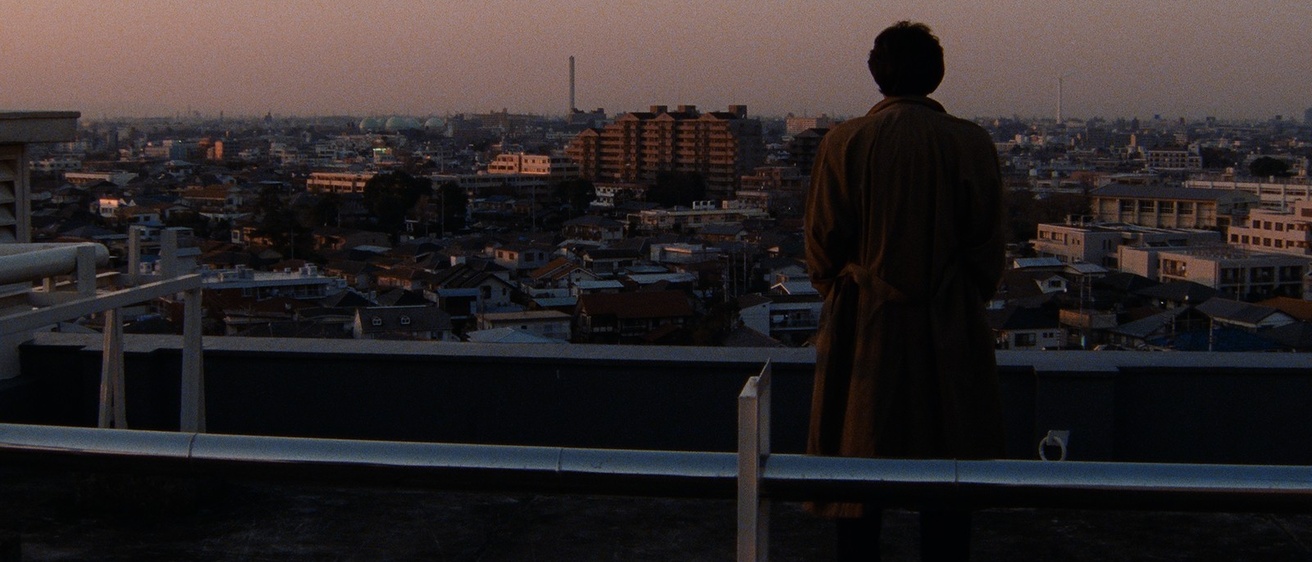
"All the things that used to be inside of me. Now they're all outside. So, I can see all the things inside you…" — Kunio Mamiya (Cure 1997, dir. Kiyoshi Kurosawa)
A haunting and invasive line from the antagonist of the Japanese psychological-horror and neo-noir film, Cure (1997). The film written and directed by Kiyoshi Kurosawa, follows Detective Kenichi Takabe (Koji Yakusho) and a string of non-related killings, all with one common denominator—an X carved into the throat of each victim. It masterfully dealt with prominent issues in Japanese society, especially the reserved, isolating culture that was starting to be built during the wake of economic turmoil. Cure depicts a “deal with the Devil,” though the Devil here is neither Abrahamic nor religious. Instead, it takes the form of a hypnotic power that masquerades as societal liberation—or a “cure.” Cure—when coupled with Japanese economic and societal context and Durkheim’s anomie—is a unique view on symbolic Devil-pacting and isolationism.
Cure opens with a reading of Bluebeard—a French folktale in which a wealthy noble murders his wives—by a schizophrenic woman, Fumie Takabe, (Anna Nakagawa) in a psychiatric ward. Then introduces the protagonist, Detective Takabe, who is investigating what is presented as a string of unrelated killings—yet are oddly bound by an X carved into each victim and amnesia ridden perpetrators. A strange young man, Mamiya (Masato Hagiwara), is introduced, who appears to suffer from severe memory loss. He disorients those he interacts with through constant and repetitive questioning. After showing a Zippo lighter to a teacher he meets named Hanaoka, the teacher murders his wife–carving another X. Takabe later meets with forensic psychologist Shin Sakuma (Tsuyoshi Ujiki), where they question Hanaoka. Takabe continues his relentless interrogation, regardless of Hanaoka starting to have a mental breakdown. Mamiya is shown in a police box with two officers, once again using his lighter to hypnotize. Mamiya leaves while the older police officer, Oida, methodically pulls out a pistol, executes his coworker—carving an X once again in the body. Oida is later interrogated by Takabe and Sakuma, where he confesses that he secretly hated his coworker. Mamiya while at a hospital berates a female doctor with sexist comments, and then spills a glass of water, letting it spread across the floor–another hypnotic suggestion. Robotically, the doctor goes to a men’s bathroom, and murders the first man she sees. Eventually Mamiya is found hiding inside the basement of the hospital, and arrested. Mamiya, in the interrogation room constantly prods Takabe with questions on who he is, causing the detective to have outbursts, having to be physically removed from Mamiya so he did not attack him. After inspection, Mamiya appears to have a large burn on his back, leading Takabe to a steel factory where Mamiya lived and worked. Inside the apartment they discover that he was a psychology student studying German doctor Franz Mesmer’s Animal Magnetism, the first theory of hypnotism. Takabe visits Sakuma’s apartment where he is shown a tape from the late 1800s depicting Suejiro Bakuro, the first Japanese hypnotist. Takabe travels to the abandoned hospital where the tape was recorded, where he finds Mamiya who had escaped prison. The Detective shoots Mamiya repeatedly, walks over to a phonograph, presumably recorded by Bakuro, and listens to it. The film cuts to the decomposed corpse of Fumie with an X carved into her throat, followed by Takabe emotionlessly receiving news of his wife’s death. In the final scene, he hypnotizes his server, who is seen grabbing a knife and walking to one of her coworkers.
While the film Cure is quite nuanced in its storytelling and imagery, it contains an overall theme of repression and isolation. Isolation is something that is a much more common part of Japanese culture in the 21st century, yet it stems from the 1990’s (Vogel, 688). In the 1980’s, Japan was seeing the peak of its “Economic Miracle”—that being the shocking success of Japan’s economy post-WWII through industrialization. (Halton, 2). The cause being the US’s interference. Learning from former mistakes in WWI, the US changed its foreign policy with defeated past enemies to promote growth rather than stifle which would breed hatred (Gerstel & Goodman, 6). This caused a trade surplus with the US, low interest rates, and a loose monetary policy which led to high speculation and real estate valuations (Halton, 1). The economy that was thriving, was creating a bubble, a bubble that subsequently burst in the early 1990s. This created what was dubbed the “Lost Decade”, a 10-year long recession in Japan (Halton, 3). The Lost Decade had a profound impact on the psyche of the Japanese population of the time, causing depression, reclusivity, and suicide rates to skyrocket. The Japanese term Hikikomori, refers to young adults with extreme cases of social withdrawal, and started during the Lost Decade (Teo & Gaw, 2). Social withdrawal is already an issue, but coupled with Japan’s more reserved culture in terms of psychiatric help for mental disorders, it became even more pronounced (Ayukawa, 16) (Vogel, 707). Social isolation is just one of many parts of societal breakdowns that occur during depressions and major changes within a community. Japan’s spontaneous industrialization during the mid-to-late 20th century, along with the crash, is another cause of the moral, social and mental breakdown displayed within Cure.
In 1893 France, one of the founding fathers of sociology, Emile Durkheim, wrote Division of Labor in Society and later wrote On Suicide in 1897 on the topic. Within both books, Durkheim introduced his theory of anomie, a social condition of breakdown in values, bonds, and norms within a community. As Emile Durkheim was born at the end of the French Industrial Revolution, he saw the impacts of a society becoming automated too quickly. In Division of Labor in Society, Durkheim writes on these effects, mainly the distance between people widening through industrialized work and life. He postulated that automation artificially distanced laborers from each other, their employers, and the actual work they produced (Durkheim, Division of Labour, 458). Durkheim believed that this separation causes less worker-solidarity and increases isolation of individuals. He wrote,
In all these cases, if the division of labor does not produce solidarity it is because the relationships between the organs are not regulated; it is because they are in a state of anomie (Durkheim, Division of Labour, 415).
Here, Durkheim is speaking on the solidarity of the worker (the organs) and how the lack of bond creates the state of anomie. In Japan, it is believed by sociologists that modernity facilitated the weakening of the traditional bonds between laborers, increasing the breakdown of social cohesion (Parigi & Henson, 156). In his later work On Suicide, he writes that not only does anomie’s normlessness cause suicide, it increases rates of homicide as mental exhaustion, social bonds, and the idea of unity within a system degrades with it (Durkheim, On Suicide, 400). Festering of hatred and frustration are heightened during states of anomie—and said states breed within economic and societal upheaval. Cure, within the context of Japan’s Lost Decade, is an image of anomie’s effects on a society.
The film displays the state of anomie of not only the general populace, but also through the characters of Takabe and Mamiya. Interestingly, the first two killers shown in the film have no obvious motives or negativity, yet in contrast, the latter three are shown theirs outright. The police officer Oida states himself that he hated his uptight, finicky coworker, and that the frustration finally let out. The doctor, Miyajima, was sexualized constantly by male patients and had been sidelined as a general practitioner by her male colleagues, who refused to let a woman become a surgeon. Miyajima's hatred boiled over into her getting her “revenge” against essentially the first man she saw. The final manipulated individual shown in the film is Takabe’s server, who after being whispered something presumably upsetting by a coworker, grabs a knife and heads to the kitchen. The non-hypnotized are shown in the film to have the same deep rooted frustration with society–in a sense disproving any idea that Mamiya is carefully selecting the unstable. Even in an early scene of the film, when a dry-cleaner messes up a regular salaryman’s clothes, the man whispers how he will get his revenge on the clerk. Humorously, he changes demeanor the moment the clerk comes back to the front desk. The general populace are shown throughout the film in vignettes of anomie and repressed hatred, yet are not fleshed out as much as the two central characters.
To start, Mamiya is the only industrial laborer shown in the film, as he worked and lived in a steel plant. His large burn on his back is a physical representation of his frustrations with society, yet his isolation is an even greater cause. Mamiya lived alone next to the factory, where his living situation and place of work were one and the same. Mamiya was unable to escape industrialization even within his own home, which Durkheim would argue to be a great factor in Mamiya’s actions. While Takabe is shown to be a proficient detective, he is riddled with his own frustrations and anger issues. Takabe is extremely frustrated with not being able to find the cause of the murders in the beginning, attacking the hypnosis victims. Takabe’s wife Fumie’s worsening condition is an additional part of his problems. Takabe feels isolated even in his own home, with him eating alone, and framed in each scene as almost an intruding figure in the empty landscape. In Chris Fujiwara’s essay on Cure for Criterion, he masterfully writes
[The film] predisposes the viewer to see the world of Cure as a limitless psychiatric clinic. Locked within separate cells, the characters concern themselves with private obsessions. Even when they share the same space, they often remain isolated. (Fujiwara, 4).
This feeling of isolation within a crowded society is prevalent in the entire film, and is what Durkheim would claim to be a condition of anomie. Takabe is isolated in almost every part of his life, it builds and builds inside of him; a dark mass that destroys his sensibilities. That dark mass is what Mamiya speaks about in his conversation with the doctor, “All the things that used to be inside of me. Now they're all outside.” He no longer is bound to his bottled emotions, he considers himself free from norms and moral obligations. Mamiya is anomie personified–a symbol of societal breakdown disguised as relief–and that is where Takabe finds himself at the end of the film.
The symbolism in Cure is too important and well-executed to ignore, containing vast and meaningful imagery throughout. The opening scene itself is symbolic: it opens with Bluebeard, a legend in which the nobleman cursed with a blue beard lashes out on his wives, one after another. Bluebeard, mocked for his unnatural blue beard, could be interpreted as driven by the insecurity of his unnatural hair color. Fumie’s mention of Bluebeard’s death by his seventh wife is ironically inverted, as she becomes a victim of Takabe in the penultimate scene. Takabe himself becomes Bluebeard, and any hope that Fumie would take the role of the seventh wife is lost. Even the title of the film itself is a symbol. Mamiya, who is described as a “missionary” by Sakuma, is delivering the “cure” to the individuals he hypnotizes. The “cure” being the breaking of any moral chain from society—granted he tears any sense of a moral compass away from his victims. The most obvious piece of symbolism is that of Mamiya’s hypnotic suggestions, namely the Zippo lighter. One must open the hinge of a Zippo to let the light free, making the lighter’s case a symbol for social constraints, while the fire is the true spirit of each individual. Mamiya letting the flame out is breaking each mesmerized person out of their own cage.
A significant piece of symbolism, that is unlike the others, is the animals found in the scene where Takabe investigates Mamiya’s apartment. The first aspect of this symbolism is the sight of several birdcages, where the birds sit calmly, seemingly indifferent to Takabe’s intrusion. However, among them is one animal that stands out—a monkey. Unlike the others, the monkey exhibits a clear sense of urgency, trying to draw Takabe’s attention in an apparent bid for escape. The monkey could be interpreted as a symbol for the subconscious of man, caged by the confines of norms and societal pressures, trying to escape in any way it can. That being said, there is a second monkey within the apartment–that being a mummified one Takabe discovers under a sheet. The mummified remains are bound in an X by string, a haunting image that, while initially unsettling, carries deeper meaning. The monkey is free from the cage, yet is bound once again, a reading symbol for Mamiya himself. The first monkey can be retrospectively read as Takabe trying to internally break free, and Mamiya being the monkey that broke free into new constraints, that of his pact with his devil.
Cure shows no ordinary “deal with the Devil” in its story, it is rather a symbolic while fantastical examination of issues in industrialization, isolation, and repression. Cure is not religious in its pact, the “Devil” is not Abrahamic yet it is not a realistic evil either. In other Devil-pacting media such as Klaus Mann’s 1936 novel Mephisto, the Devil is symbolic as well, yet is a historical human evil, the Nazi party. Cure and Mephisto’s pacts are similar in certain aspects and extremely different in others. In both pacts, the pacter is reluctant in dealing with their respective devils. Takabe is initially hunting his predecessor before becoming a pacter himself, finalizing his pact with the playing of Bakuro’s phonograph. Mephisto’s protagonist, the actor Hendrik Höfgen is a staunch adversary to the Nazi regime, opposing his devil in the first section of the book. Yet similar to Cure, there is a slow burn, where the protagonist starts to give in. Hendrik slowly gives in throughout the novel, culminating in his reluctant handshake with the Prime Minister, solidifying the “deal with the Devil”. Yet Hendrik, when pacting, constantly displays recognition of his own cognitive dissonance. Klaus Mann writes, “Now I have contaminated myself, thought Hendrik. Now there is a stain on my hand that I can never wash off…Now I have sold myself…Now I am marked for life…” (Mann, 180). This acknowledgement of what the pacter has done in contrast to his morality is something unseen in Cure. Unlike most Devil-pacting stories Takabe does not show any regret in his decisions and as a pacter he is satisfied with what he has achieved. The pact with the Devil is perceived as liberating by its recipients in Cure, removing any bindings that society enforces on individuals. Within the film, the pact attempts to be a “cure” for the effects of industrialization, but ironically is a symbol for it.
In Cure, the pact with the Devil is an exaggerated representation of anomie and it is, at its core, an absurd attempt to escape turmoil within the society of its time. The pacters use the hypnotic powers to liberate their fellow man, but end up just becoming another disease in their community. The film addresses the issues of isolation and repression, but introduces the pact as an unreasonable, dangerous poison masquerading as its own cure. The film is a critique on not only industrialization, repression, and isolation but the idea that a removal of norms and morality is a cure. Kurosawa displays that a release of internalized issues all at once is no remedy for turmoil in civilization. The film Cure expertly navigates the problems within Japanese society through pacting, symbolism and the concept of anomie—it is a criticism of its contemporary culture, yet strikes down the alternative of social breakdown. Cure is a call for unity through disorder, not an acceptance of chaos.
Works Cited
Cure. Directed by Kiyoshi Kurosawa, Shochiku-Fuji Company, 27 Dec. 1997.
Durkheim, Emile. Suicide: A Study in Sociology. London, Routledge, 1897.
Durkheim, Émile. The Division of Labor in Society. 1893. New York, Free Press, 2014.
Fujiwara, Chris. “Cure: Erasure.” The Criterion Collection, 18 Oct. 2022,
Gerstel, Dylan, and Matthew P. Goodman. “Japan: Industrial Policy and the Economic Miracle.” From Industrial Policy to Innovation Strategy: Lessons from Japan, Europe, and the United States, Center for Strategic and International Studies (CSIS), 2020, pp. 5–9.
Halton, Clay. “Lost Decade.” Investopedia, 27 Sept. 2021,
Kurosawa, Kiyoshi. “Cure.” IMDb, 8 July 2001,
Levy, Marion J. “Some Implications of Japanese Social Structure.” The American Sociologist, vol. 31, no. 2, 2000, pp. 18–31. JSTOR,
Mann, Klaus. Mephisto. Translated by Robyn Smyth, Penguin, 1 Sept. 1995. Banerjee 11 Parigi, Paolo, and Warner Henson. “Social Isolation in America.” Annual Review of Sociology, vol. 40, 2014, pp. 153–71. JSTOR.
Suzanne Hall Vogel. “Japanese Society under Stress.” Asian Survey, vol. 52, no. 4, 2012, pp. 687–713. JSTOR.
Teo, Alan R., and Albert C. Gaw. “Hikikomori, a Japanese Culture-Bound Syndrome of Social Withdrawal?” The Journal of Nervous and Mental Disease, vol. 198, no. 6, June 2010, pp. 444–449.